California Zone 0 Draft Regulations – Summary (April 2026)
On Thursday, April 23, 2026, the Board of Forestry and Fire Protection, held a Zone 0 Regulatory Advisory Committee Meeting at the Calabasas Community Center, to present a draft of their most recent Rule Plead Summary. The following is a summary of the Draft Regulations. Please click on the button below to review the full summary.
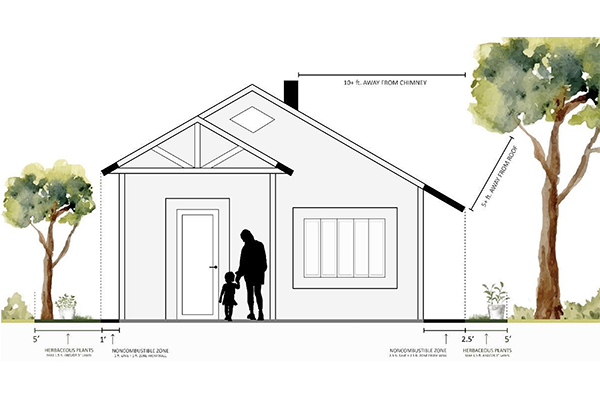
What is Zone 0? The first 5 feet surrounding a home or structure, identified as the most critical area for wildfire defense because it’s where wind-blown embers land and ignition is most likely.
Who must comply? Property owners in State Responsibility Areas (SRAs) and Very High Fire Hazard Severity Zones in Local Responsibility Areas (LRAs). New construction must comply immediately upon adoption. CLICK HERE and enter your home address to find your Fire Hazard Severity Zone (FHSZ).
Two-Phase Implementation for Existing Homes
Phase 1 (within 3 years): Remove combustible materials like firewood, mulch, wood chips, dead leaves; clean gutters; remove dead/dying plants; trim trees per the new rules.
Phase 2 (within 5 years, timeline set locally): Create a non-combustible “safety zone” directly under eaves, replace combustible gates, and update sheds and fencing.
Key Rules
- No combustible materials anywhere in Zone 0 (mulch, wood chips, fallen leaves, firewood, etc.)
- Trees are allowed but must be trimmed — lower branches removed up to 6 feet (or ⅓ of height), 5 feet of clearance above roofs, and 10 feet from chimneys
- Vegetation-free buffers required within 1 foot of walls, under eaves, 2 feet from windows/doors/vents, and 5 feet from attached decks
- Small herbaceous plants (non-woody, under 18″) are allowed in the outer portion of Zone 0 in spaced groupings
- Fences/gates attached to the home must have a 5-foot non-combustible span; no new combustible fences within 5 feet of the structure
- Sheds/outbuildings in Zone 0 must be built entirely of non-combustible materials
Flexibility
Local fire agencies can authorize alternative practices tailored to local geography, fire risk, lot size, or building design, as long as they are equally or more protective than the state standards.
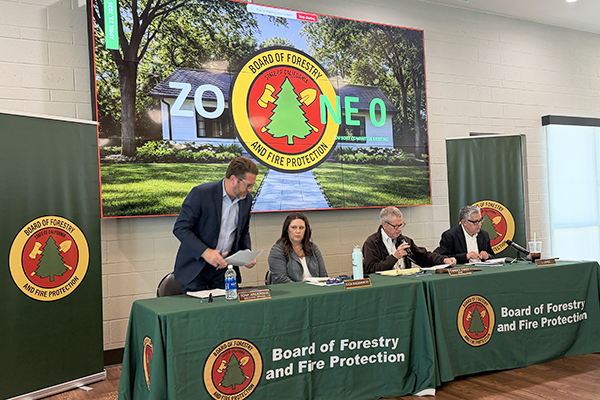
(L-R) Tony Andersen, Executive Director, Elicia Goldsworthy, Board Member, Terrence O’Brien, Board Chair, J. Lopez, Public Member.
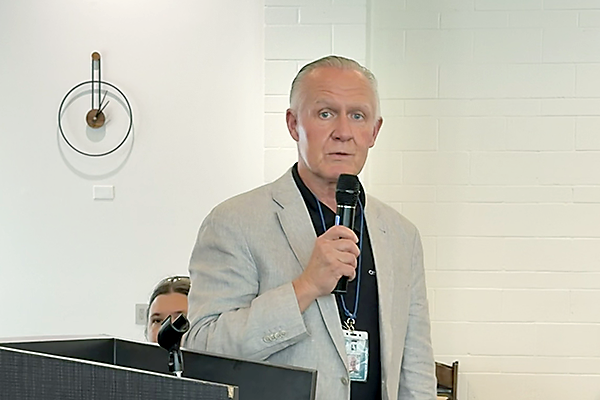
Michael Dyer, MPA, CWMS, Director of Public Safety and Emergency Preparedness for the City of Calabasas, introduced the Board of Forestry Representatives.