Great news: Governor Newsom has signed the first-in-the-nation standards for testing and remediating hazardous wildfire smoke contamination for future fires and requires insurers to cover qualifying smoke damage, testing, remediation, and restoration.
California Enacts First-in-Nation Standards for Smoke-Damaged Homes
In the ashes of the January 2025 wildfires, thousands of Los Angeles-area homeowners have faced a frustrating limbo: their houses never burned, but they aren’t sure it’s safe to move back in. Governor Gavin Newsom recently signed two new laws designed to end that uncertainty — Assembly Bill 1642 and Assembly Bill 1795 — as part of a broader wildfire recovery package.
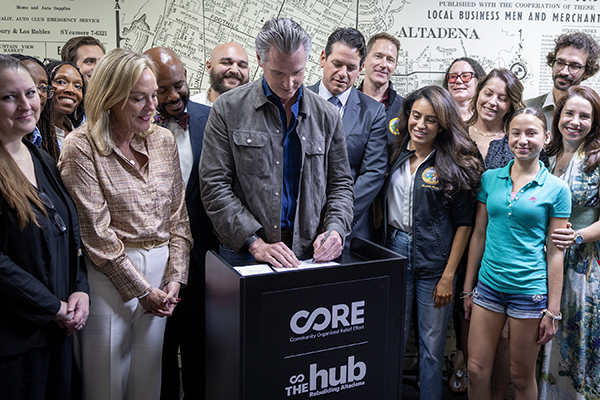
Newsom signed the legislation in Altadena during a meeting with survivors of the Eaton Fire, saying the new protections would make insurer obligations clearer and give homeowners more financial flexibility when they need it most. The timing wasn’t incidental. According to the California Department of Insurance, more than 13,000 of the roughly 40,000 insurance claims filed after the January 2025 fires involve smoke damage to homes that never actually burned — and until now, no state in the country had enforceable standards for how those homes should be tested, cleaned, or restored. (For more info: CA)
AB 1642: Setting the Science
AB 1642, authored by Assemblymember John Harabedian of Pasadena, directs the state’s Department of Toxic Substances Control (DTSC) to establish standards for testing, repairing, and removing lead and asbestos contamination by the end of 2028, with standards for other toxic materials and contaminants to follow by the end of 2029. Until those new standards are finalized, existing federal and state exposure standards will continue to apply. (For more info: CalMatters)
The bill also requires DTSC and the California Air Resources Board to develop the state’s first protections for testing, remediation, and restoration of smoke-related lead and asbestos contamination for homes located within a fire’s affected zip codes, and requires DTSC to issue guidance to help schools recover after a wildfire.
AB 1795: The Smoke Damage Recovery Act
The companion bill, authored by Assemblymember Mike Gipson and sponsored by Insurance Commissioner Ricardo Lara, establishes a legal presumption that smoke damage found within a wildfire’s impact zone actually came from that fire — shifting the burden of proof away from homeowners. The law requires insurers to pay for necessary testing and sampling, and prohibits them from cutting off Additional Living Expense benefits until a home is restored and confirmed safe to occupy.
It also sets timelines for inspections and claim handling, requires repair estimates that bring homes back to their pre-loss condition while meeting health and safety codes, and preserves a policyholder’s right to choose their own restoration contractor.
Gipson framed the bill as a matter of basic dignity for disaster survivors. “For homeowners who have already lost so much in a fire, the last thing a family should have to do is fight for a clear answer about whether it is safe to return home,” he said in a statement.
Why Now
The push comes amid mounting legal pressure on insurers. The state insurance department, fire survivors, and Los Angeles County have all filed lawsuits or other legal action against State Farm and the state’s last-resort FAIR Plan over how they’ve handled smoke-damage claims, and just last week the county opened an investigation into Farmers Insurance over similar complaints.
The two bills didn’t arrive alone. Harabedian also authored AB 1842, signed the same day, which creates a statewide mortgage forbearance program for homeowners whose houses are deemed uninhabitable after a major disaster. That builds on AB 238, signed the previous year, which gave eligible homeowners up to a year of mortgage forbearance and launched a $125 million state relief fund covering up to $100,000 per household.
Both AB 1642 and AB 1795 take effect January 1, 2027, giving state agencies and insurers a runway to prepare — though for the thousands of families still waiting on answers about their own homes, the real test will be how quickly those protections translate into action.
So proud to have helped harmonize and get these two bills to the Governor for his signature.
These new laws will save lives, restore real property assets, and reduce costly claim disputes.
– Amy Bach, Executive Director at United Policyholders
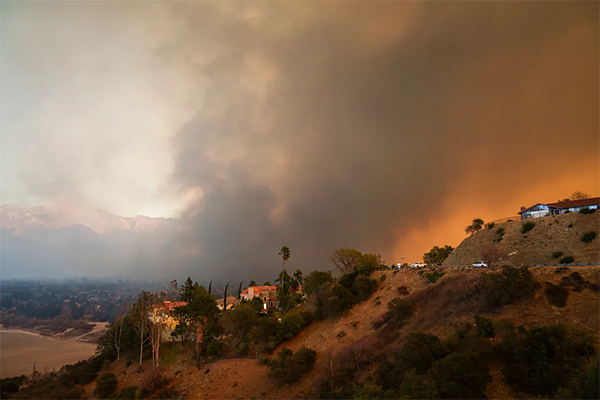
Smoke from the Eaton Fire fills the sky in La Cañada Flintridge on Jan. 8, 2025. Hills and canyons are critically dry.
Photo by Jules Hotz for CalMatters
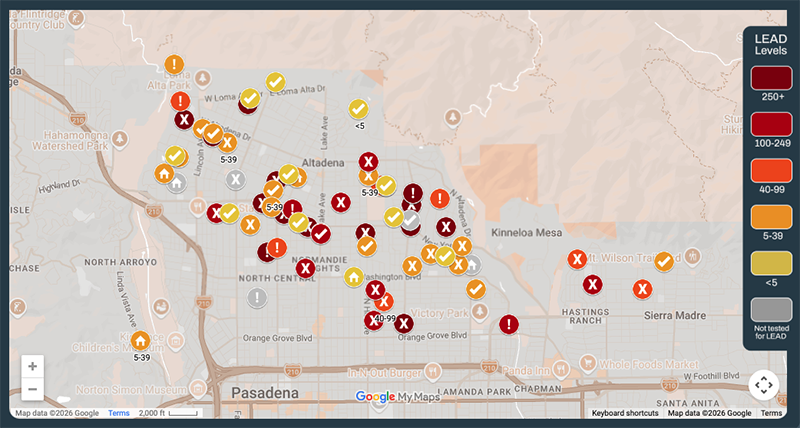
Image Courtesy: Eaton Fire Residents United
71 standing homes were professionally tested.
This map contains data on lead, asbestos, the CAM17 metals, lithium, and wildfire debris.
The substances tested vary from home to home.
For more information, visit: https://www.efru.la/map-post